
Microneedling has a broad enough research base to give a straight answer, and it is more measured than the marketing: it helps some things, does little for others, and carries small but documented risks. Clinic Finder is a directory, not a clinic, so here is what the evidence supports, what it costs, and what to check before booking.
What microneedling actually is
Microneedling, or collagen induction therapy, uses very fine needles to make thousands of tiny punctures through the skin’s outer layer into the dermis below. That is the whole mechanism: no heat, no light, no chemical.
What matters is what the skin does next. The punctures trigger the same three-stage repair sequence the body uses for any wound: inflammation, as immune cells arrive and release growth factors; proliferation, as fibroblasts lay down new type III collagen and elastin; then remodelling, which runs for months as weak type III collagen converts into the stronger type I collagen that gives skin its structure.
Crucially, the epidermis is not removed: the micro-channels close quickly and the basement membrane stays intact, which is why microneedling is proposed as a lower-risk alternative to ablative lasers and deep peels. Lower risk is not no risk.
What the evidence actually supports
Acne scarring: the strongest case
A 2020 systematic review of 33 published studies found every one reported improvement in atrophic acne scars. That consistency is unusual in aesthetics.
The caveat is effect size. A 2022 meta-analysis of 12 randomised trials and 414 patients found a statistically significant but modest objective improvement. Individual studies read better: ten patients given six sessions showed 51% to 60% scar improvement, and a series of 37 found 94% moved at least one grade down the severity scale. All are small and mostly unblinded.
Combinations beat microneedling alone. A network meta-analysis of 24 trials and 1,546 patients ranked microneedling plus chemical peels best of the strategies compared, and a trial of 30 patients found 31% improvement alone against 62% with a 35% glycolic peel added. Adding platelet-rich plasma, across 14 studies and 472 patients, made more than 50% improvement about three times as likely.
Lines and texture: real but patchy
The best wrinkle data come from trials manufacturers ran for US device clearance, and should be read accordingly. In one, 32 of 35 people with a mean age of 56 completed four monthly treatments. Blinded assessors found improvement in all twelve facial areas measured: cheek fine lines improved in 87.5% of patients, a mean reduction of 40.5%. At three months a clinician rated 81.3% improved and 6.3% worse, and 65.6% would recommend it. Three authors were employees of the funder.
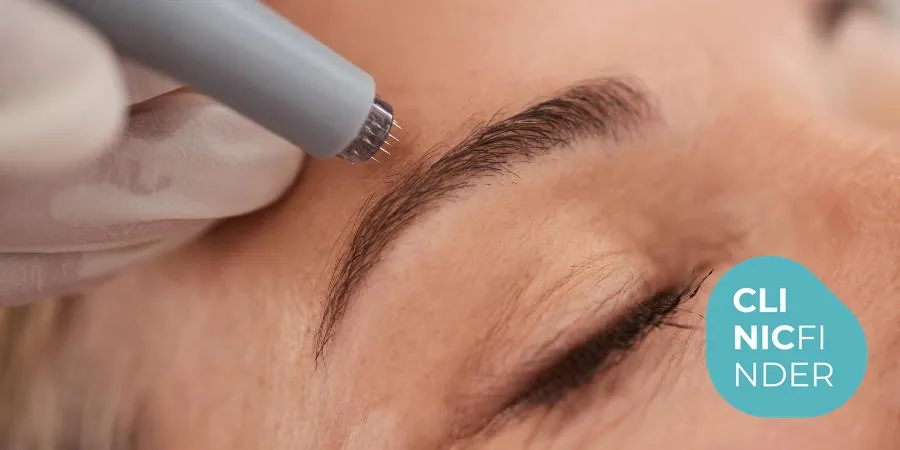
A second trial of 48 patients found at least one grade of improvement in 85% to 90% of patients between the brows, around the eyes and in the cheek folds, with nobody worse, but no clinically meaningful improvement in horizontal forehead lines, nasolabial folds or upper lip lines. Any clinic promising uniform results across the face is going beyond its own evidence.
Stretch marks, melasma and hair
Stretch marks have decent data: in 25 patients across lighter and darker skin types, every one achieved at least 50% improvement after an average of 1.8 treatments, and 28% by more than 75%, with no infections or pigment changes. A meta-analysis of 11 studies found microneedling beat non-laser comparators, matched lasers and scored higher on satisfaction, but hurt significantly more.
For melasma and hair loss it is a delivery route rather than a treatment. A trial of 60 patients found tranexamic acid delivered by microneedling gave 44% improvement in melasma severity against 36% by injection, and in hair loss 100 patients randomised in 2013 showed 82% of the microneedling plus minoxidil group reporting more than 50% improvement against 4.5% on minoxidil alone. In the UK that is off-label use.
What it costs in the UK
A single professional facial session sits broadly between £145 and £300 across UK price lists. One national chain lists £200 for the face and £275 including the neck and décolletage, plus a £50 consultation, with courses cutting the per-session price by 10% to 25%. Scar work by a doctor runs to around £400 a session, platelet-rich plasma puts a session in the £220 to £650 bracket, and advertised courses run from about £750 to £1,800.
The single-session price is not the price of the treatment, because almost nobody is treated once. And price tracks who holds the device and where the clinic is, far more than any difference in outcome.
How many sessions, and how long results last
Professional bodies agree on the shape of a course and differ on the detail: 3 to 5 treatments every 2 to 4 weeks (American Academy of Dermatology), at least three roughly monthly (American Society for Dermatologic Surgery), or 3 to 4 about six weeks apart, up to six for scars and stretch marks (British College of Aesthetic Medicine). Cleared device protocols used four treatments 30 days apart.
Durability is where honesty is needed. Collagen and elastin increases have been documented at six months, but in the main wrinkle trial improvements were still present 90 days after the last session and 90 days was simply the longest anyone looked. Beyond six to twelve months there is essentially no good data, so claims of results lasting years are unsupported.
Downtime and side effects
“No downtime” is the commonest inaccuracy. In one pivotal trial every subject had redness immediately afterwards and every subject peeled between days three and eight; by day eight, 81% had none left. Dermatologic surgery guidance puts typical downtime at 2 to 7 days. Numbing cream is applied 30 to 60 minutes beforehand; in the same trial 77% reported soreness at day three but only 4% by day eight.
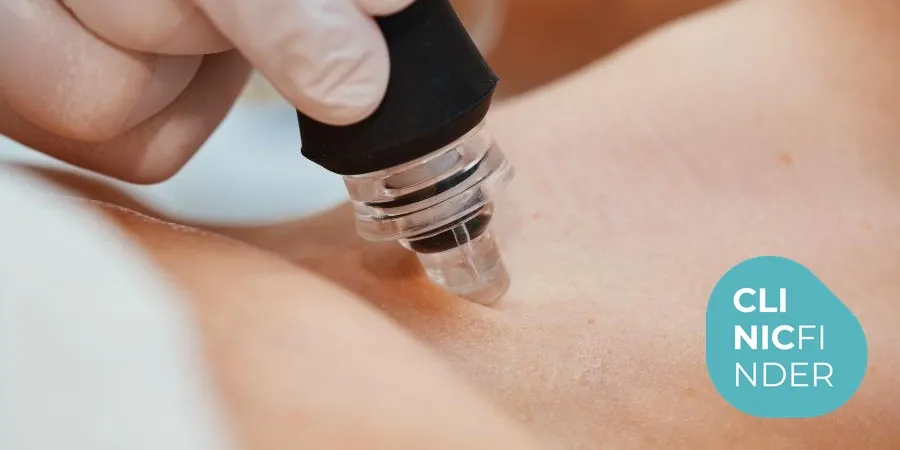
The largest safety synthesis, 51 articles and 1,029 patients, shows that device type matters. With motorised pens, 83.7% had redness and 72.1% pain; with rollers, 51.1% had redness and 53.2% pain, but rollers also carried a 6.8% rate of post-inflammatory hyperpigmentation and a 10.5% rate of tram-track scarring: small, regularly spaced raised marks along the roller’s path. That argues strongly for a clinic that uses a pen.
Rarer problems are documented. Delayed granulomatous reactions, firm inflamed plaques appearing weeks later that can take months of steroid treatment to settle, are repeatedly linked to vitamin C serum applied during or just after treatment: anything put on freshly needled skin is being delivered into it, and most cosmetic topicals were never tested for that. Cold sores are a quantified risk: in one trial 13 of 48 subjects had a history and 8 of those had an outbreak, all mild. Cartridges are single-use and must never be shared.
Who should avoid it
Guidance advises against microneedling if you have a keloid or hypertrophic scarring tendency, heal slowly, are immunosuppressed or take isotretinoin. UK guidance adds pregnancy and breastfeeding, anticoagulants and active skin infection. Metal allergy is a relative contraindication, and the national occupational standard says under-18s must be refused. The device trials also excluded recent trauma, severe active acne, pre-cancerous lesions and current smokers, a fair guide to who the evidence does not cover.
Darker skin deserves nuance. Microneedling compares favourably with ablative lasers because it spares the epidermis, but pigment change is still the leading risk in Fitzpatrick IV to VI skin, so conservative depth, adequate gaps between sessions and strict sun protection matter.
At-home rollers versus professional treatment
A high street derma roller costs roughly £13 to £23, around 1% to 2% of a clinic session, and the physical gap is just as wide: home rollers typically carry needles shorter than 0.15 mm, while professional devices work at 0.5 mm to 3.0 mm, the depths at which the published collagen data were generated.
No head-to-head trial of home versus professional microneedling has been published, so nobody can honestly quote a number. The only randomised home-device data sits in hair loss, where 29 people using a device twice weekly for six months showed improvements that reached significance in no group. Dermatology bodies say home rollers cannot produce the same benefits, and the AAD warns home use can spread warts and cold sores and cause scarring: one woman spread chickenpox virus across her face after rolling affected chest skin, and atypical mycobacterial infection has been reported after home use.
A short-needle home roller is a superficial exfoliation and product-penetration tool, not collagen induction therapy.
Claims that outrun the evidence
- “400% more collagen.” Real, but a maximum histological increase six months after four sessions in small early series, not a typical result. Independent work in 11 patients found no relevant increase in epidermal thickness.
- “FDA approved.” No microneedling device is FDA approved. A few are authorised or cleared, a lower bar, and US clearance has no standing in the UK.
- “90% would recommend it.” A marketing figure; the trial that manufacturer sponsored found 65.6%.
- “Same as Morpheus8, only cheaper.” Radiofrequency microneedling is a different, more intensive treatment, and in the 2022 meta-analysis mechanical microneedling reached significance where fractional radiofrequency did not.
What to look for in a clinic
There is still no national licence for microneedling in England: the Health and Care Act 2022 created the power to introduce one and a green, amber and red tiering has been proposed, but the scheme is not yet law. Wales licenses special procedures and some English councils require a special treatment licence, so most checking falls to you. Worth asking:
- Who is treating me, and to what depth are they insured? The national occupational standard limits therapists to 0.5 mm to 1.0 mm on the face and 1.5 mm on the body, and says deeper needling is medical and likely to void their insurance. Frameworks differ, which is itself worth knowing.
- Pen or roller? Pooled data put tram-track scarring at 10.5% with rollers.
- Are cartridges sterile, single-use and opened in front of me?
- What goes on my skin during and afterwards, and why? Vitamin C serum is linked to delayed granulomatous reactions.
- Is my history properly taken, including cold sores, keloid tendency, isotretinoin, pregnancy and anticoagulants?
- Is the practitioner on a recognised register, and the clinic regulated where required?
Microneedling is genuinely useful with a real, if unglamorous, evidence base: best on atrophic acne scars, decent on some fine lines and stretch marks, and oversold nearly everywhere else. As a course of three to six sessions costing several hundred pounds, with a week of visible recovery and results measured in months, it is a reasonable choice. Against the marketing, it will disappoint.