Morpheus8 reaches deeper than mechanical microneedling and heats tissue at the tip. Its FDA clearance covers coagulation and haemostasis, not wrinkles, cellulite, contouring or fat reduction — and in October 2025 the FDA reported burns, scarring, fat loss, disfigurement and nerve damage after RF microneedling.
Evidence reviewed •UK-focused•No clinic controls this guide
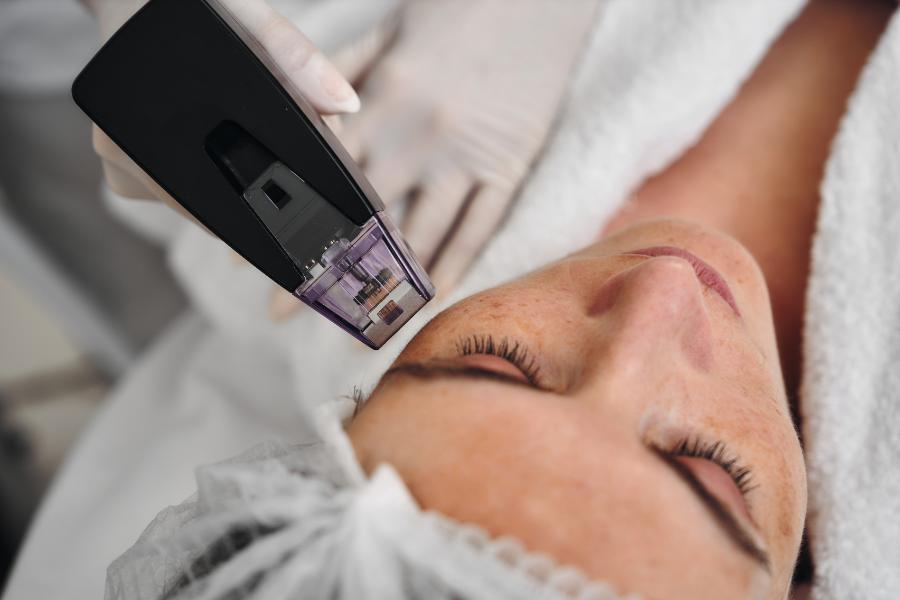
Illustrative RF microneedling treatment; devices, tips and settings vary. Depth and energy are chosen by the operator for each area, and the one independent review of this field named user error as the highest single source of complication risk.
Main aim
Heat and remodel deeper tissue
Technology
Needles plus 1 MHz bipolar RF
FDA clearance
Coagulation and haemostasisWrinkles, cellulite, contouring and fat reduction are not cleared uses
Typical plan
Often three sessionsThree to six weeks apart in the published protocol
Downtime
2–5 days to 3 weeksClinics quote 2–5 days; the manufacturer describes swelling and crusting over 1–3 weeks
Key context
FDA safety alert, Oct 2025
Start here
What it is — without the sales pitch
Morpheus8 is a branded fractional radiofrequency microneedling platform made by InMode. An array of insulated, gold-coated needle electrodes is pushed to a depth the operator selects, and bipolar radiofrequency at 1 MHz is delivered between them, coagulating tissue at the needle tips. Because the shafts are insulated except for the last half-millimetre, the heat is concentrated at depth rather than at the surface. Mechanical microneedling involves no heat at all: this is a different modality, not a stronger version of the same one.
Depth is the genuine differentiator. The FDA summary for the first Morpheus8 clearance states a maximum treatment depth of 4.0 mm, while the manufacturer’s instructions offer 1–7 mm plus roughly a further millimetre of thermal effect; competing RF microneedling devices generally stop around 3.5–4.0 mm. That reach is why the device is used on jowls, the submental area and the body — and it is also the source of its distinctive harm. An independent review of 180 face and neck lifts names Morpheus8 specifically, describing subcutaneous fat loss and contour irregularities in the areas corresponding to needle penetration.
The clearance is much narrower than the marketing. Morpheus8 is 510(k) cleared, never “FDA approved”, as an electrosurgical device for dermatologic procedures where coagulation or contraction of soft tissue, or haemostasis, is needed. No clearance names wrinkles, acne scars, cellulite, stretch marks, body contouring or fat reduction. Two competing devices hold broader cosmetic indications — Vivace for facial wrinkles and Profound for facial wrinkles and the appearance of cellulite. The 2023 expansion of the Morpheus8 wording was supported by bench data on animal tissue; the clearance summary records “Clinical Performance Data: Not Applicable”.
Our bottom line
The FDA’s own position is that RF microneedling is a medical procedure, not a cosmetic treatment. If you go ahead, do it with someone who can state the depth and energy they will use on each area, whose consent form names burns, scarring, fat loss, disfigurement and nerve damage, and who is not selling it as fat reduction or a non-surgical facelift.
What it may help with
Moderate laxity of the lower face, jawline or neck, if you accept an uncertain and modest effect
Active acne and older acne scarring, where a retrospective series reported a lower three-year relapse rate than isotretinoin or ablative laser — though its authors were InMode consultants and the supplement was sponsored by InMode
Someone who specifically needs energy delivered deeper than mechanical microneedling reaches, and who understands that the depth is also where the risk comes from
What it will not do
Reduce fat or contour the body — no clearance mentions either, and fat loss appears in the FDA’s list of reported harms
Replace a facelift; in an independent series, previous deep RF microneedling made later surgical correction harder
Reliably outperform laser — an independent randomised neck comparison favoured 1550 nm non-ablative fractional laser by 42.1% to 8.6% on wrinkle score
Come with a proven duration of benefit
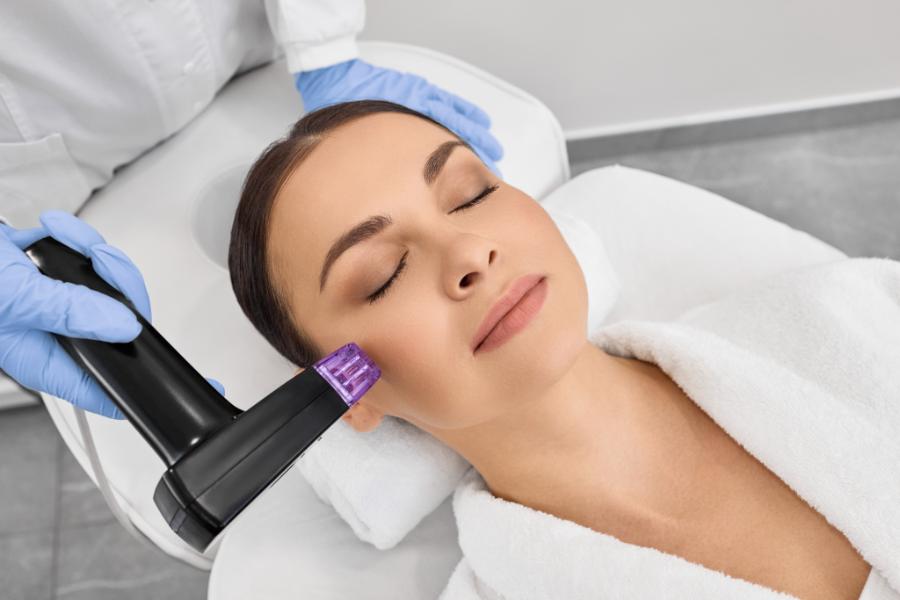
Illustrative RF microneedling handpiece — the device shown is not necessarily a Morpheus8. Morpheus8 tips carry 12, 24 or 40 pins and are single-use, with energy reaching under 5% of the surface area at a time.
Know which claim belongs to which device
Branded, generic and mechanical: three different evidence positions
Morpheus8 is one device within a category, and that category sits alongside a needle-only treatment which shares its name but not its risks. Claims travel between them far too easily.
01
Fractional bipolar RF microneedling
Morpheus8 for the face
Insulated needles at roughly 1–4 mm on the face with radiofrequency delivered at the tip, used for laxity of the lower face, jowls and neck, and for acne and acne scarring.
What the evidence tells us
The largest dataset is 247 patients whose Baker Face/Neck score improved by a mean of 1.4 points, with 93% reported as pleased — but Morpheus8 was combined with FaceTite or BodyTite, the journal supplement was funded by InMode and every author was an InMode consultant. The same cohort was published a second time, which is not independent replication.
Keep in view
Complications in that cohort included prolonged swelling beyond six weeks in 4.8%, hardened areas beyond twelve weeks in 3.2% and neuropraxia in 1.2%.
02
Deeper and newer configurations
Morpheus8 Body and Burst
A 40-pin body tip at 2–7 mm, and the current Burst generation that delivers multiple depths and energy levels in a single pulse.
What the evidence tells us
InMode markets a category it calls subdermal adipose remodelling. That is a marketing category, not an FDA device classification. No peer-reviewed clinical study specific to Morpheus8 Burst was identified, and InMode does not publish numeric depths for it.
Keep in view
Body contouring and fat reduction appear in no Morpheus8 clearance, while fat loss appears in the FDA’s list of reported harms. A clinic selling “fat melting” is describing something the regulator lists as a complication.
03
Genius, Potenza, Secret RF, Vivace, Profound
Other RF microneedling brands
The same broad approach with different needle counts, insulation, frequencies and depths, mostly reaching 3.5–4.0 mm.
What the evidence tells us
Morpheus8 goes deeper and its needles are insulated along the shaft, which concentrates heat at the tip. On regulatory breadth it is behind two competitors: Vivace holds an FDA indication for facial wrinkles in Fitzpatrick I–V and Profound for facial wrinkles and the appearance of cellulite. Profound also uses real-time temperature sensors targeting 65–75 °C.
Keep in view
No head-to-head trial of Morpheus8 against another RF microneedling brand was identified, so claims of superiority within the category are unsupported. The FDA’s 2025 safety communication is class-wide, not device-specific.
04
Needles only, no radiofrequency
Mechanical microneedling
Shallower needling to trigger a wound-healing response, without heat.
What the evidence tells us
For the narrow use it covers, the clearance pathway is arguably stronger: SkinPen’s facial acne-scar indication was granted with clinical study data, and a 2022 meta-analysis found mechanical microneedling significant for acne scars where fractional RF microneedling was not.
Keep in view
Much cheaper, shallower and lower-risk, and outside the FDA’s RF safety communication. It also cannot reach subcutaneous tissue, which is the entire rationale for RF microneedling in the first place.
Results & trade-offs
What to realistically expect
01
This is a medical procedure
That is the FDA’s wording, not ours. Its October 2025 communication states that RF microneedling “is a medical procedure, not a cosmetic treatment”, and that these devices should not be used at home.
02
The clearance is narrower than the marketing
Cleared wording covers electrocoagulation, haemostasis and coagulation or contraction of soft tissue. Wrinkles, acne scars, cellulite, stretch marks and fat reduction are not cleared uses, and the 2023 expansion was granted on bench data with no clinical performance data submitted.
03
Downtime is often longer than a few days
Published protocols describe two to five days, visible grid marks last one to two weeks, and the manufacturer’s instructions describe swelling and crusting resolving over one to three weeks. Plan around the wider range.
04
Longevity figures in adverts are not from trials
The longest peer-reviewed follow-up is an average of 2.1 years in a sponsor-funded retrospective study. The familiar “one to three years” traces to clinic marketing pages, not to published data.
R
Research in context
What research can — and cannot — tell us
The Morpheus8 literature is dominated by retrospective series, several funded by the manufacturer and written by its consultants. No sham-controlled trial was identified, the one review that excluded industry-funded studies rated the field at the lowest level of evidence, and the FDA issued a safety communication on RF microneedling in October 2025.
A large share of the Morpheus8 literature sits in journal supplements sponsored by InMode and written by InMode consultants, including the flagship 247-patient dataset that was published twice. The only systematic review that explicitly excluded industry-funded studies rated the RF microneedling evidence base at the lowest level of evidence and named user error as the highest source of complication risk. No sham-controlled trial of Morpheus8, and no trial against another RF microneedling brand, was identified.
Safety
Risks should be part of the decision
“Non-surgical” does not mean risk-free. The exact device or product, treatment area, practitioner and your health all change the risk.
01
Common or expected
Pain during treatment; topical or local anaesthesia is normal, and in a 25-patient study of an off-label medical use at sites including the groin and thigh, pain led 12% to stop treatment
Redness, swelling and a visible grid pattern for one to two weeks
Crusting at the treated points, exfoliating over one to three weeks, sometimes with pinpoint bleeding
02
Important complications
The FDA’s safety communication of 15 October 2025 reports burns, scarring, fat loss, disfigurement, nerve damage and the need for surgical repair after RF microneedling, and says its evaluation is ongoing
Loss of subcutaneous fat and contour irregularity: an independent review of 180 face and neck lifts named Morpheus8 and found smooth cervical contours “exceptionally difficult, if not impossible” to achieve afterwards
Nerve injury — neuropraxia occurred in 1.2% of the largest published cohort
Pigment change: hyperpigmentation and hypopigmentation appear in the manufacturer’s own adverse-event list, and energies above 62 mJ per pin are restricted to Fitzpatrick I–IV in the FDA clearance
Prolonged swelling beyond six weeks (4.8%) and hardened areas beyond twelve weeks (3.2%)
03
Get prompt medical advice
Blistering, an open wound or skin that breaks down
New numbness, weakness or an uneven smile
A dent, hollow or contour irregularity appearing in a treated area
Swelling or firm lumps still present weeks after treatment
If you feel seriously unwell or have trouble breathing, seek urgent medical help. This page cannot assess an individual complication.
Suitability
A consultation should sometimes end with “no”
It may be reasonable to explore if…
The concern is moderate laxity of the lower face, jawline or neck, or acne and acne scarring, and expectations are conservative
A suitably qualified healthcare professional is performing it, and the consent form names burns, scarring, fat loss, disfigurement and nerve damage as the professional societies now advise
You accept that the treatment is not cleared for fat reduction or contouring, and that fat loss is a reported harm rather than a selling point
Pause and get individual advice if…
A pacemaker, defibrillator or any other metallic or electronic implant, or permanent implants in the treatment area
Pregnancy or breastfeeding, a history of cancer, impaired immunity, poorly controlled diabetes or thyroid disease, bleeding disorders, or anticoagulants within the last 10 days
Keloid history, abnormal wound healing, active skin disease in the area, or recurrent herpes simplex without antiviral cover
Isotretinoin within the past six months, filler in the area until it has dissipated, facial surgery within the past year, recent resurfacing or laser, or tanning within the past two weeks
Fitzpatrick V and dark VI skin, which the manufacturer says should be treated with caution, capped at low energy and escalated slowly
The treatment journey
What good care should look like
01
Consultation and screening
Establish who is performing the treatment and who is clinically accountable. Screening should cover implants, pregnancy, cancer history, clotting and anticoagulants, keloids, herpes, isotretinoin in the past six months, recent filler, surgery or resurfacing, and recent tanning. Agree the depth and energy for each area and for your skin type.
02
Test spot and preparation
The manufacturer’s instructions call for a test spot in an inconspicuous area before the first full session and for the lowest output setting that will do the job. Topical anaesthetic — commonly a lidocaine and tetracaine gel for one to two hours — is usual, and tips are single-use.
03
The session
Needles are inserted to the set depth and radiofrequency is delivered at the tip, area by area. A published facial protocol uses at least 500 pulses, more in severe cases. Expect a grid pattern, some pinpoint bleeding and real sensation despite the anaesthetic.
04
Aftercare and review
The instructions require SPF 30 or higher and protection from sun for at least a month, with tanning avoided across the whole course. Typical plans are three sessions three to six weeks apart. Report late numbness, firmness or contour change rather than waiting for the next appointment.
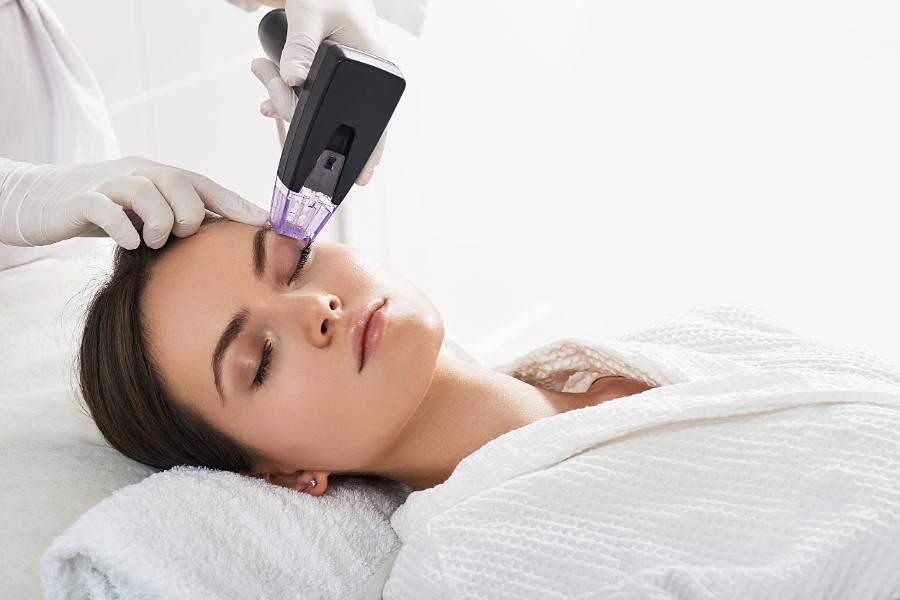
Illustrative treatment; protocols and settings vary by device. Grid marks can stay visible for one to two weeks, and Morpheus8’s manufacturer instructions describe swelling and crusting settling over one to three weeks.
Compare your options
The alternative is not always another procedure
No treatment or skincare
Avoids a procedure the FDA describes as medical; topical routines improve surface quality but not laxity.
Mechanical microneedling
Shallower, cheaper and outside the FDA’s RF safety communication; pooled data support it for acne scars where fractional RF microneedling was not significant.
Shallower, but Vivace holds a facial-wrinkle indication and Profound holds wrinkle and cellulite-appearance indications that Morpheus8 does not.
Non-ablative fractional laser
Outperformed RF microneedling on neck wrinkle score in an independent randomised comparison, 42.1% against 8.6%.
Surgery
A larger and more predictable change, with anaesthetic and surgical risk. Tell any surgeon about previous RF microneedling — it can make the operation harder.
Take this to your consultation
Questions worth asking before you pay
01
Are you a regulated healthcare professional, and who is clinically accountable if something goes wrong?
02
What depth and energy will you use on each area, and why those settings for my skin?
03
Does your consent form name burns, scarring, fat loss, disfigurement and nerve damage?
04
What is Morpheus8 actually cleared for — can you show me the wording?
05
Will you do a test spot first, and what energy cap applies to my skin tone?
06
Realistically, how long will grid marks, swelling and crusting last?
07
What evidence supports the result you are describing, and who funded it?
08
If I later want a facelift, how does having this treatment affect that?
Source library
Research and guidance behind this page
We link to guidance and papers so you can check the evidence yourself. A source appearing here does not mean every claim or conclusion in it is beyond debate.
Reports burns, scarring, fat loss, disfigurement, nerve damage and the need for surgical repair, states that RF microneedling is a medical procedure rather than a cosmetic treatment, and confirms the FDA evaluation is ongoing.
The current cleared wording: dermatologic procedures where coagulation or contraction of soft tissue, or haemostasis, is needed. The summary records “Clinical Performance Data: Not Applicable”.
Classifies the device as electrosurgical, records bipolar radiofrequency at 1 MHz up to 65 W and a 4.0 mm maximum treatment depth, and restricts energies above 62 mJ per pin to Fitzpatrick I–IV.
The independent review of the field, declaring no funding or conflicts: rates the evidence base at the lowest level of evidence, names user error as the highest source of complication risk and notes grid marks persisting one to two weeks.
The largest Morpheus8 dataset — 247 patients, a mean 1.4-point Baker score improvement, neuropraxia in 1.2% — but combined with FaceTite or BodyTite, funded by InMode, with all authors company consultants.
Independent review of 180 face and neck lifts, declaring no funding: names Morpheus8 in relation to subcutaneous fat loss and contour irregularity corresponding to areas of needle penetration.
Independent randomised comparison in 21 patients: the laser improved the wrinkling score by 42.1% against 8.6% for RF microneedling, though RF did better on horizontal neck wrinkles.
American Society for Laser Medicine and Surgery / American Society for Dermatologic Surgery
The societies hold that RF microneedling is safe and effective in appropriate settings, while urging members to add burns, scarring, fat loss, disfigurement and nerve damage to their consent forms.
Society response published the day after the FDA communication, emphasising that seemingly simple cosmetic treatments require real understanding of skin structure and function.
Retrospective comparison including 139 RF microneedling patients, reporting a lower three-year acne relapse rate than isotretinoin or ablative laser; the authors are InMode consultants and the supplement was sponsored by InMode.
The manufacturer’s own document, cited here for depth settings, contraindications, skin-type energy caps, single-use tips and aftercare rather than as evidence of effectiveness.
Places hybrid radiofrequency-plus-microneedling devices in the proposed amber tier for England; the scheme still requires further legislation before it takes effect.
Proposes restricting needling deeper than 1.5 mm, and any listed procedure performed under anaesthetic, to appropriate healthcare professionals in Scotland.
Common questions
Frequently asked questions
Is Morpheus8 FDA approved?
No. It is 510(k) cleared, a substantial-equivalence route rather than approval. The cleared wording covers electrocoagulation, haemostasis and coagulation or contraction of soft tissue in dermatologic procedures. It does not mention wrinkles, acne scars, cellulite, stretch marks, body contouring or fat reduction.
What did the FDA say about RF microneedling in October 2025?
On 15 October 2025 the FDA published a safety communication reporting burns, scarring, fat loss, disfigurement, nerve damage and the need for surgical repair. It stated that RF microneedling is a medical procedure rather than a cosmetic treatment, that these devices should not be used at home, and that its evaluation is ongoing. The American Academy of Dermatology responded the following day, and the ASLMS and ASDS later said the treatment is safe and effective in appropriate settings while urging members to add those specific risks to their consent forms.
Can it melt fat or contour the body?
No Morpheus8 clearance mentions fat reduction or body contouring. “Subdermal adipose remodelling” is InMode’s own marketing category rather than a regulatory classification. Independent surgical literature documents subcutaneous fat loss as an unwanted complication, and fat loss appears in the FDA’s list of reported harms. A clinic offering fat loss as the benefit is describing something the regulator lists as a risk.
Is it better than plain microneedling?
It is different. It reaches deeper and adds heat, which mechanical microneedling cannot do. But mechanical microneedling holds the stronger clearance for the use it covers, and a 2022 meta-analysis found it significant for acne scars where fractional RF microneedling was not. Choose by what you are trying to change, not by price tier.
Is it better than other RF microneedling devices?
No head-to-head trial against another RF microneedling brand was identified, so superiority claims within the category are unsupported. Its real technical differentiator is depth and full-shaft insulation. On regulatory breadth it is behind two competitors, since Vivace holds a facial-wrinkle indication and Profound holds wrinkle and cellulite-appearance indications.
How long do the results last?
There is no controlled durability study. The longest peer-reviewed follow-up is an average of 2.1 years in a manufacturer-funded retrospective. The “one to three years” and “12 to 18 months” figures used in advertising come from clinic marketing pages. Dermatologists quoted in the consumer press describe the effect as not permanent, with annual maintenance suggested.
How much downtime should I plan for?
Published protocols describe two to five days, visible grid marks last one to two weeks, and the manufacturer’s instructions describe swelling and crusting settling over one to three weeks. In the largest published cohort, 4.8% had swelling lasting beyond six weeks. Plan for the wider range rather than the shortest one.
Is it safe for every skin tone?
That needs qualification. The FDA clearance restricts energies above 62 mJ per pin to Fitzpatrick I–IV. The manufacturer’s instructions say skin types V and dark VI should be treated with caution, capped at a low energy level, started at the minimum and escalated slowly at three-to-four-week intervals. Review literature advises reducing energy in types IV–VI and avoiding the superficial resurfacing tip in V–VI.
Who is allowed to perform it in the UK?
There is no national licensing scheme in force in England. The government’s proposed scheme explicitly places hybrid radiofrequency-plus-microneedling devices in the amber tier, which would require a licence and, for non-healthcare practitioners, oversight by a named regulated healthcare professional. Scotland’s proposals would place needling deeper than 1.5 mm, or any listed procedure carried out under anaesthetic, in a group restricted to healthcare professionals.
Clinic directory
Compare clinics offering Morpheus8
Directory information is separate from our editorial assessment. Inclusion is not a medical endorsement.