Morpheus8 has been one of the UK’s most heavily promoted aesthetic treatments for five years, helped by a celebrity endorsement and a great deal of confident language about tightening and remodelling. It is also, since October 2025, the subject of a safety warning most clinic pages have not caught up with.
This guide covers what it is, what the research supports, what it costs, and where marketing has run ahead of evidence. Clinic Finder is a directory, not a clinic, so we have nothing to sell you.
Morpheus8 versus plain microneedling
Both push needles into the skin. Only one heats the tissue once they are in, and that changes the depth reached, the regulatory category, the downtime and the risk profile.
| Plain microneedling | Morpheus8 (RF microneedling) | |
|---|---|---|
| How it works | Needles puncture the skin and trigger a wound-healing response. No heat | Mechanical injury plus bipolar radiofrequency at 1 MHz from insulated needle tips, adding controlled heat |
| Depth and tissue reached | Up to 2.5 mm on SkinPen, not evaluated above 1.5 mm: epidermis and upper dermis | 4.0 mm in the FDA summary, 1 to 7 mm in the manual plus roughly 1 mm thermal: dermis and, above 4 mm, subcutaneous fat |
| Cleared cosmetic use | SkinPen: facial acne scars in adults aged 22 and over, plus neck wrinkles | None. Only electrocoagulation, haemostasis and soft-tissue coagulation or contraction |
| Evidence behind the clearance | De Novo route, supported by clinical study data | Special 510(k) recording “Clinical Performance Data: Not Applicable” |
| Downtime | Generally lower | 2 to 5 days in published protocols; 1 to 3 weeks of swelling and crusting per the manufacturer’s manual |
| Proposed UK licensing | England: green, the lowest tier. Scotland: Group 1 at 1.5 mm or less | England: amber, named explicitly as a hybrid device. Scotland: Group 3, healthcare professionals only |
Morpheus8 adds a controlled burn at a depth needles alone cannot reach. That depth is both the reason to consider it and the reason to be careful.
How it works, and what depth really means
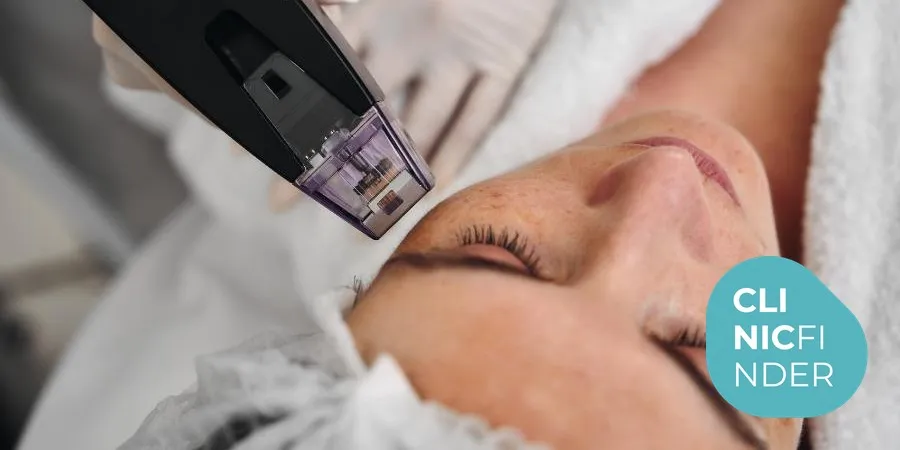
Morpheus8 is a fractional bipolar radiofrequency microneedling platform made by InMode, an Israeli device company. Its needles are gold-coated and insulated except for the final 0.5 mm, so when radiofrequency current passes at 1 MHz between pairs of pins at up to 65 watts, the heat lands only at the tip, at the depth dialled in, sparing the surface. Energy hits under 5% of the area at a time, leaving untouched tissue between to speed healing.
Depth is a dial in millimetres setting how far the pins travel, with roughly another millimetre of heat spreading past the tip, so a 4 mm setting heats to nearer 5 mm. Published practice uses 1 to 2 mm on the face and 3 to 4 mm on the body, with settings above 4 mm reserved for areas having at least a centimetre of fat beneath. Note that the FDA summary states a 4.0 mm maximum, not the manual’s 7 mm.
Energy is a second dial, 5 to 60, controlling how much heat lands at that depth, targeting soft tissue at around 50 degrees Celsius while holding the surface at 40 to 42. No sensor manages that for you; it is the operator’s choice, which is why the independent review of this device class named user error as the largest source of complication risk.
What the evidence actually shows
Around 16 records come up on PubMed for Morpheus8. There is no sham-controlled randomised trial of it, and the only systematic review that excluded industry-funded studies rates radiofrequency microneedling at Level of Evidence 5, the weakest tier.
The most cited dataset is a 247 patient retrospective series for neck laxity and jowling, Baker scores improving a mean 1.4 points with 93% of patients pleased. Two caveats: Morpheus8 was combined with FaceTite or BodyTite, and the supplement was co-funded by InMode with every author an InMode consultant. A second paper reporting 2.1 year average follow-up reuses the same patients.
For acne, a 2025 retrospective across 356 patients reported a three-year relapse rate of 24% in the radiofrequency microneedling arm against 67% for isotretinoin and 75% for ablative laser, with an acne scar subgroup improving on the ECCA scale from 178 to 132. Encouraging numbers, same problem: InMode-sponsored supplement, InMode consultant authors.
The most useful independent result is less flattering. A randomised split comparison on the neck, 21 patients over three treatments, found 1550 nm non-ablative fractional laser beat radiofrequency microneedling on wrinkle score by 42.1% to 8.6% and on elastosis by 41.3% to 16.3%. Radiofrequency microneedling won on one measure only, horizontal neck wrinkle severity, so “better than laser resurfacing” is not supportable.
Cellulite and stretch marks appear constantly in advertising. The one Morpheus8 cellulite publication is a case series with no retrievable sample size or outcomes, and it is Profound, a competitor, that holds the FDA cellulite indication. For stretch marks there is no Morpheus8-specific evidence at all.
The FDA warning, and the fat loss question
On 15 October 2025 the FDA published a safety communication on radiofrequency microneedling reporting burns, scarring, fat loss, disfigurement, nerve damage and cases needing surgical repair. Its bluntest line is that radiofrequency microneedling “is a medical procedure, not a cosmetic treatment”. It covers the whole device class rather than Morpheus8 alone, and the FDA’s evaluation is ongoing.
The professional response was measured rather than alarmed. The American Academy of Dermatology stressed that treatments which look simple still demand real understanding of the skin. In December 2025 the American Society for Laser Medicine and Surgery and the American Society for Dermatologic Surgery jointly called the procedure safe and effective in appropriate settings, while urging members to name burns, scarring, fat loss, disfigurement and nerve damage on their consent forms.
The fat loss signal did not start with the FDA. Independent surgical evidence got there first.
A 2025 retrospective review of 180 face and neck lifts, by authors declaring no funding and no conflicts, found fibrosis between skin and the underlying fascia in patients who had previously had deep radiofrequency microneedling. It names Morpheus8, describing contour irregularities where needles had penetrated and reporting that the lost subcutaneous fat made a smooth neck contour “exceptionally difficult, if not impossible”.
Keep that proportionate. Those were people already presenting for surgery, the study is retrospective, and it gives no rate for the wider treated population. It is not a reason to assume harm. It is a good reason to treat “melts fat” as a warning rather than a selling point, and to tell any future surgeon what you have had done. In that series, 4% did not.
Who may legally perform it in the UK
England and Scotland diverge here, and this is the most practical section.
In England no licensing scheme is in force. Powers exist under the Health and Care Act 2022 and the Government consulted in 2023, drawing over 11,800 responses, but a scheme still needs further consultation and Parliamentary time. Under the proposals, plain microneedling sits in the green tier while hybrid radiofrequency plus microneedling devices are named explicitly as amber: a non-medic would need a licence and oversight by a named regulated healthcare professional.
Scotland is stricter. Independent healthcare services must register with Healthcare Improvement Scotland, and operating unregistered is a criminal offence. The June 2025 proposals would place microneedling deeper than 1.5 mm, and any listed procedure using an anaesthetic, in Group 3: doctors, dentists, prescribing nurses and prescribing pharmacists only. Morpheus8, at 1 to 7 mm and normally under anaesthetic, trips both. No commencement date has been published.
One further layer: in Greater London, premises offering “special treatments” need a licence under the London Local Authorities Act 1991, and boroughs commonly list radiofrequency machines as licensable.
What it costs, and what to expect
UK price lists captured in 2026 run from about £200 for a chin to £1,800 for a large body area. Courses of three are the usual unit: roughly £945 to £1,450 for the eye area, £1,650 to £2,200 for a full face, £1,750 to £3,000 for face and neck, and £840 to £3,835 for the body. Who performs it moves the number sharply, with one London clinic listing a full face at £1,050 with a senior doctor and £1,580 with a lead doctor.
Published protocols run to 1 to 3 sessions spaced 3 to 6 weeks apart, though UK clinics more often sell 3 to 6, with topical anaesthetic beforehand and around an hour in the chair. Longevity is unestablished: the longest peer-reviewed follow-up averages 2.1 years, from a manufacturer-funded retrospective, and the “1 to 3 years” figure traces to clinic marketing.
Side effects and who should avoid it
The manufacturer lists pain, excessive redness, swelling, crusting, blistering, burns, pigment change in both directions, and scarring. Post-inflammatory hyperpigmentation is a particular concern in deeper skin tones: the FDA clearance restricts higher energies to Fitzpatrick types I to IV, and InMode’s manual says types V and dark VI need caution and an energy cap. Marketing claiming it is “safe for all skin types including VI” is not reflecting that manual.
Contraindications include pacemakers and other metallic or electronic implants, pregnancy and breastfeeding, a history of cancer, poorly controlled diabetes or thyroid disease, immunosuppression, bleeding disorders or anticoagulants within 10 days, keloid scarring, active skin infection or cold sores without prophylaxis, recently tanned skin, isotretinoin within 6 months, dermal filler until it has dissipated (up to 6 months), and facial surgery within the past year.
What to ask before you book
These questions separate clinics.
- Who will hold the handpiece, and what clinical register are they on? Ask for a name and registration number, not a job title.
- In Scotland, is the service registered with Healthcare Improvement Scotland? In London, is there a special treatment licence?
- What depth and energy will be used on me, and why those settings for my skin type?
- Will a test patch be done in a discreet area first? The manufacturer instructs operators to do exactly that.
- Does your consent form name burns, scarring, fat loss, disfigurement and nerve damage? Two professional societies say it should.
- How many of these have you performed, and who manages a complication if one happens?
- What is the total course price, and what does maintenance cost a year from now?
A clinic that answers all seven without flinching is telling you something useful. So is one that does not.