Percutaneous collagen induction — needling without radiofrequency
The acne-scar literature is broad and consistently positive in direction, but the studies are small and the pooled effect modest. The strongest wrinkle trial was run by a device manufacturer, several facial areas did not respond at all, and durability beyond a few months is essentially unstudied.
Evidence reviewed •UK-focused•No clinic controls this guide
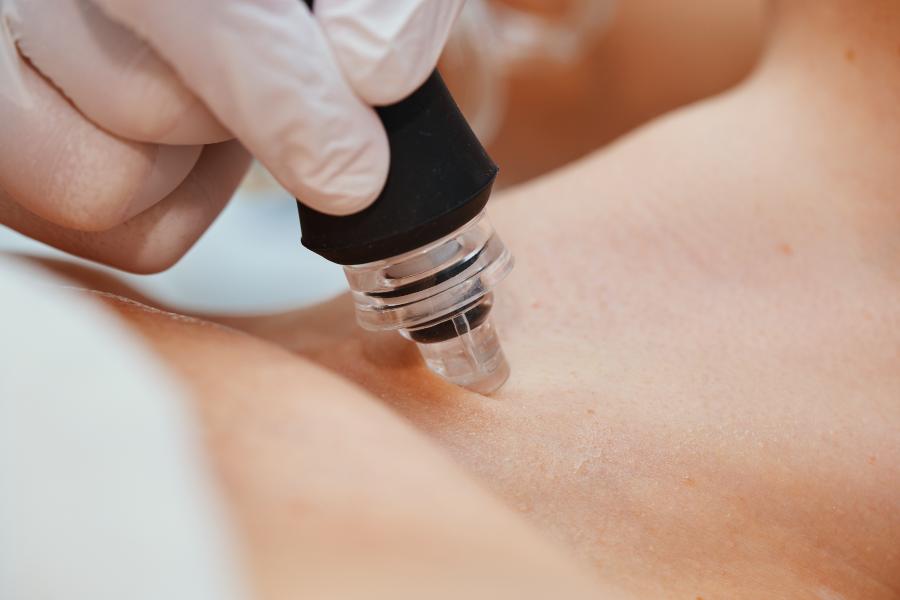
Microneedling is used on the body as well as the face. Pooled data record tram-track scarring in 10.5% of roller-treated patients, which is a strong argument for pen devices with sterile single-use cartridges over rollers.
Main aim
Trigger collagen repair
Best-supported use
Atrophic acne scarring
Typical plan
3–5 sessionsSocieties suggest 2–6 week intervals
Downtime
About 2–7 days
UK depth limits
Set by training, not statuteSKAB38 caps therapists at 0.5–1.0 mm on the face
Key limitation
Durability barely studied
Start here
What it is — without the sales pitch
Microneedling — also called percutaneous collagen induction — uses fine needles to make thousands of controlled micro-punctures through the epidermis into the dermis. The injury triggers the ordinary wound-healing sequence, and collagen and elastin are laid down over the following months. Because the epidermis and basement membrane are left essentially intact, it was proposed as a lower-risk alternative to ablative laser resurfacing and deep peels, particularly for the risk of pigment change.
The device matters more than the word. Pooled safety data give a clear reason to prefer a pen over a manual roller: post-inflammatory hyperpigmentation was recorded in 6.8% of roller-treated patients and tram-track scarring in 10.5%. Needle length is also not the same as needle penetration — skin tenting, applied pressure and device speed all reduce how deep the needles actually reach at a given setting.
Regulation is thinner than the marketing implies. No microneedling device is FDA approved; SkinPen was authorised through the De Novo route in 2018 and Exceed cleared through 510(k), and US authorisation has no legal standing in the UK in any case. England still has no national licensing scheme in force: the government has consulted and published a proposed set of risk tiers, but it is not yet law. In practice, UK depth limits come from occupational standards and insurance rather than statute, and the different frameworks do not agree with each other.
Our bottom line
A reasonable option for atrophic acne scars, stretch marks and skin texture if you accept a course of sessions, several days of visible healing each time, and an effect that is real but usually modest. Ask what depth will be used, whether that sits inside the practitioner’s qualification and insurance, and what — if anything — is being applied to skin that is temporarily open.
What it may help with
Atrophic acne scarring — the indication with the broadest supporting literature
Stretch marks: in one study of 25 patients across Fitzpatrick I–V, all reached at least 50% improvement after an average of 1.8 treatments
Selected facial areas — device trials found the glabella, periorbital skin and cheek folds responded well
Delivery of an active you are already using, such as minoxidil in pattern hair loss, where microneedling is the adjunct rather than the treatment
What it will not do
Lift or remove loose skin, or substitute for surgery
Improve every part of the face — one pivotal trial found no clinically meaningful change in horizontal forehead lines, nasolabial folds or upper lip lines
Give the same result from a sub-0.15 mm home roller as from a clinic treatment
Produce a permanent result; the longest follow-up in the pivotal wrinkle trial was 90 days after the last session
Cartridges are single-use and must not be reused between patients. It is reasonable to ask to see the sealed cartridge opened in front of you.
Four things sold under one name
A home roller, a clinic pen and an RF device are not the same treatment
“Microneedling” is used for products and procedures that differ by an order of magnitude in depth, sterility, regulation and risk. Evidence generated with one should not be quoted for another.
01
Consumer devices
At-home rollers and pens
Sold for home use to improve texture or help products absorb.
What the evidence tells us
Home dermarollers are typically under 0.15 mm, far short of the depths at which the published collagen data were generated. No head-to-head trial of home versus professional devices was identified, and the one randomised home-device study — in pattern hair loss — found no statistically significant difference between groups.
Keep in view
Documented harms include widespread facial autoinoculation of varicella from a home roller and a Mycobacterium abscessus infection. The FDA has not authorised any microneedling medical device for over-the-counter sale. These are better understood as superficial exfoliation and product-penetration tools than as collagen induction.
02
Clinic treatment with sterile cartridges
Professional pen microneedling
A course of treatments at working depths usually between 0.5 mm and 1.5 mm, for scarring, texture or fine lines.
What the evidence tells us
This is where the evidence sits. A systematic review of 33 acne-scar articles found improvement in every one of them, and pooled randomised data confirm a statistically significant but numerically modest objective effect.
Keep in view
A therapist working to the UK national occupational standard is limited to 0.5–1.0 mm on the face and 1.5 mm on the body. Deeper needling is described there as medical use, beyond the therapist’s scope and likely to infringe their insurance cover.
03
Combination protocols
Microneedling with PRP or topical actives
Platelet-rich plasma, a chemical peel or a serum applied through the freshly made channels.
What the evidence tells us
Combinations can add measurable benefit. With PRP, the odds of more than 50% improvement in acne scarring roughly tripled across 14 studies and 472 patients, and a network meta-analysis of 24 randomised trials ranked microneedling plus chemical peels the best of the strategies compared.
Keep in view
The same channels that improve delivery are the main safety hazard: most cosmetic topicals are not formulated or licensed for intradermal use, and vitamin C serum is the product most consistently implicated in delayed granulomatous reactions. PRP involves handling blood and is a different clinical and regulatory proposition again.
04
Needles plus radiofrequency heat
RF microneedling
Devices such as Morpheus8 add radiofrequency energy at the needle tip, reaching deeper and heating the tissue.
What the evidence tells us
A different modality rather than a premium version of the same one. The 2022 acne-scar meta-analysis found mechanical microneedling significant where fractional RF microneedling was not.
Keep in view
The FDA issued a safety communication on RF microneedling in October 2025 reporting burns, scarring, fat loss, disfigurement and nerve damage. That communication applies to RF devices, not to mechanical microneedling, and the two should not be conflated in either direction.
Results & trade-offs
What to realistically expect
01
The best evidence is for acne scars
A systematic review found improvement in all 33 included articles. Pooled randomised data are more sober: an objective mean difference of 0.42, statistically significant but numerically modest.
02
Some areas do not respond
In the Exceed pivotal study, 85–90% of subjects improved at the glabella, periorbital area and cheek folds — and there was no clinically meaningful improvement in forehead lines, nasolabial folds or upper lip lines.
03
There is downtime
Every subject in that trial had redness immediately afterwards, and every one peeled between days three and eight. The ASDS describes two to seven days of downtime, so “no downtime” is not an accurate description.
04
Treat the headline number carefully
The “400% more collagen” figure is a reported maximum histological change six months after four sessions in a small body of work, not a typical outcome. A study of 11 patients found no statistically relevant increase in epidermal thickness.
R
Research in context
What research can — and cannot — tell us
Atrophic acne scarring is the best-supported use — every one of 33 articles in a systematic review reported improvement. Pooled randomised data give a modest objective effect, the strongest wrinkle trial was manufacturer-sponsored, and long-term durability has barely been studied.
The literature is broad but structurally weak: mostly small, single-centre, often unblinded studies using different scoring scales. The strongest wrinkle data come from a manufacturer-sponsored trial with 32 completers and three company employees among the authors. No head-to-head trial of home versus professional devices was identified, and durability beyond roughly six months is essentially unstudied.
Safety
Risks should be part of the decision
“Non-surgical” does not mean risk-free. The exact device or product, treatment area, practitioner and your health all change the risk.
01
Common or expected
Redness and swelling, usually settling within about a week
Pain during treatment and tenderness afterwards — pooled data record pain in 72% of pen-treated patients
Dryness, flaking and peeling, typically around days three to eight
02
Important complications
Post-inflammatory hyperpigmentation — 6.8% with rollers in pooled data, and the leading risk in Fitzpatrick IV–VI skin
Tram-track scarring: regularly spaced papular scars along the device’s path, recorded in 10.5% of roller-treated patients
Delayed granulomatous hypersensitivity, repeatedly linked to vitamin C serum used around the procedure; in one published case the rash was still visible after six weeks of steroid treatment
Infection and viral reactivation — 8 of 13 subjects with a herpes history had an outbreak in one pivotal trial, and home devices have caused varicella autoinoculation and Mycobacterium abscessus infection
03
Get prompt medical advice
Spreading redness, heat, pus or fever
A cold sore, blistering rash or shingles-type eruption after treatment
Lumps, plaques or a rash appearing days or weeks later
Regularly spaced linear marks that do not fade
If you feel seriously unwell or have trouble breathing, seek urgent medical help. This page cannot assess an individual complication.
Suitability
A consultation should sometimes end with “no”
It may be reasonable to explore if…
Your concern is acne scarring, stretch marks or skin texture, and you can commit to a course
You accept several days of redness and peeling after each session
The practitioner works within their qualification’s depth limit and can say exactly what will be applied to the treated skin
Pause and get individual advice if…
A tendency to keloid or hypertrophic scarring, slow wound healing, immunosuppression, or current isotretinoin
Pregnancy or breastfeeding, anticoagulant therapy, active skin infection or a current cold sore
Darker skin — not a bar, but a reason for conservative depth, adequate intervals and strict photoprotection
Under-18s, who must be refused by therapists under the UK national occupational standard
The treatment journey
What good care should look like
01
Assessment and depth planning
The practitioner should identify the concern, agree the needle depth, and confirm that depth sits inside their qualification and insurance. Screening should cover keloid tendency, herpes history, isotretinoin, pregnancy, anticoagulants and active infection.
02
The session
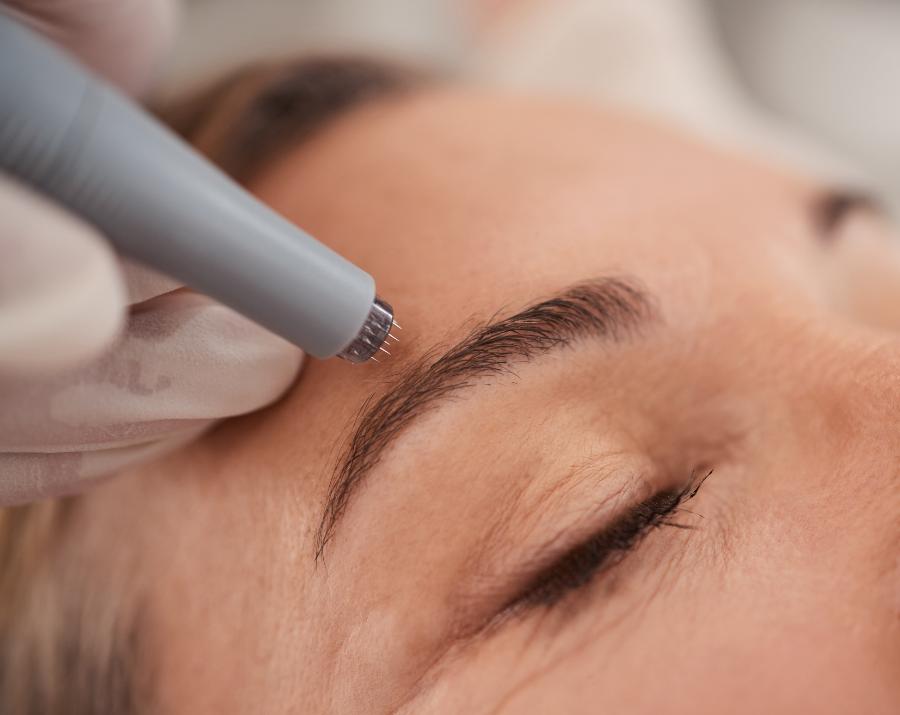
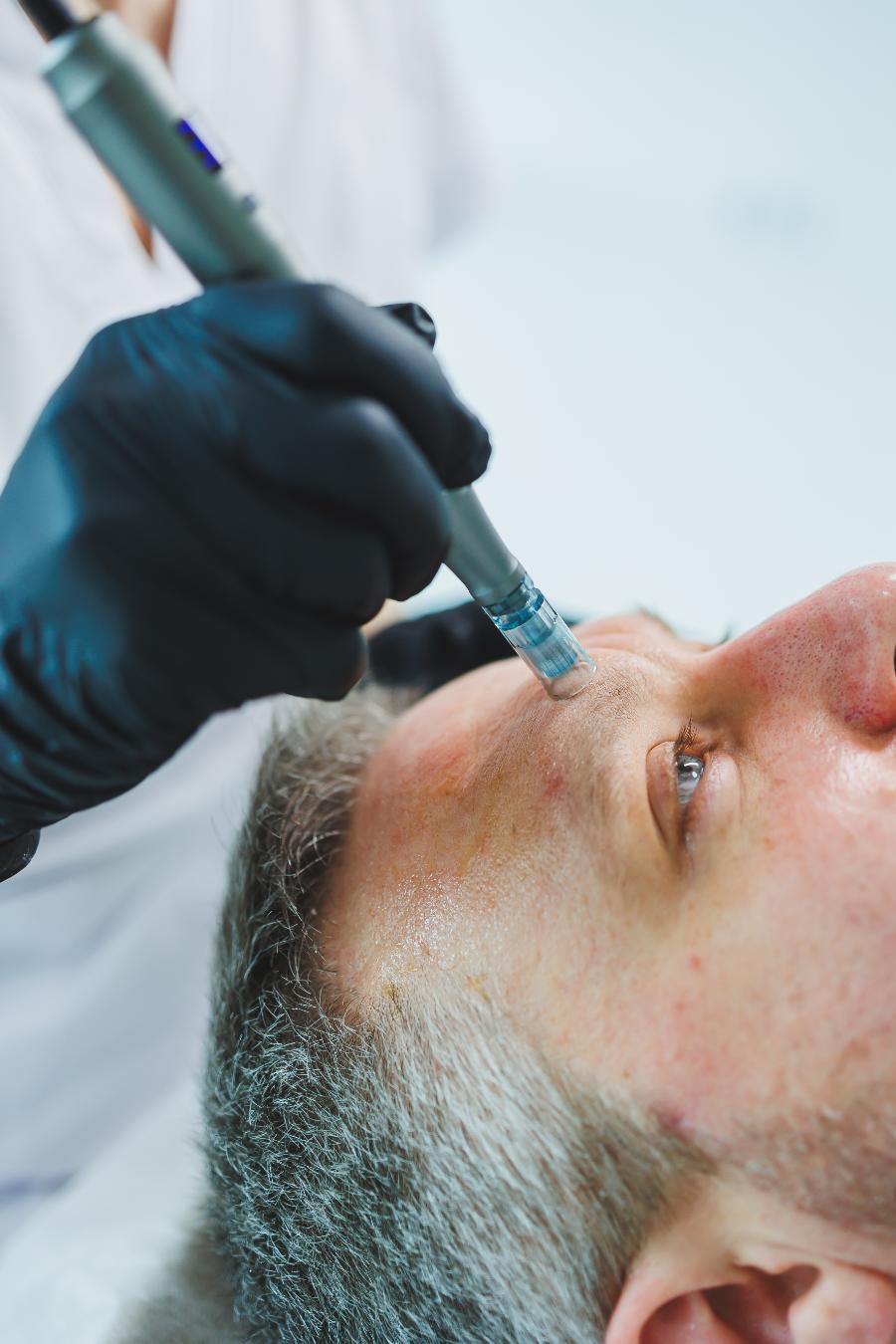
Topical anaesthetic is usually applied 30–60 minutes beforehand. A sterile, individually packaged cartridge is fitted; cartridges are single-use and must not be reused between patients. Typical working depths are 0.5–1.5 mm.
03
Healing
Expect redness immediately, then flaking and peeling around days three to eight. Most transient effects settle within about a week. Use sun protection, and report any rash, lump or unusual marking that appears later.
04
Course and review
Plans of three to five sessions are usual, spaced anywhere from two to six weeks apart depending on whose protocol is followed. Review with standardised photographs; collagen change continues for months after the last treatment.
Treatment is usually spread over several sessions. Redness straight after is expected: in one pivotal device trial every subject had it, and every subject peeled between days three and eight.
Compare your options
The alternative is not always another procedure
No treatment or good skincare
Avoids cost and procedure risk; topical routines can improve surface quality without breaching the skin.
Microneedling with PRP
Adds measurable benefit in acne scarring, but involves handling blood and is a different clinical and regulatory proposition.
Chemical peels
Combined with microneedling, ranked best of the strategies compared in a 24-trial network meta-analysis of acne-scar treatments.
RF microneedling (Morpheus8)
Deeper and heat-based, with a narrower FDA clearance and a 2025 FDA safety communication behind it. Not a premium version of the same treatment.
Will you use a pen or a roller, and which device is it?
02
What needle depth will you use, and does it sit within your qualification and insurance?
03
Is the cartridge sterile and single-use, and can I see it opened?
04
What will be applied to my skin during and after treatment, and is it intended for intradermal use?
05
How many sessions do you expect, at what interval, and what is the total cost?
06
Given my skin tone, how will you reduce the risk of pigmentation change?
07
I get cold sores — will you arrange antiviral cover first?
08
Who reviews me if I develop a late rash, lumps or marks that do not fade?
Source library
Research and guidance behind this page
We link to guidance and papers so you can check the evidence yourself. A source appearing here does not mean every claim or conclusion in it is beyond debate.
Authorised US uses are facial acne scars, facial wrinkles and abdominal scars in adults aged 22 and over; no microneedling medical device is authorised for over-the-counter sale.
Eighty-five articles separating expected transient events from persistent harms, and naming products not approved for intradermal use as a risk-increasing factor.
Twelve randomised trials and 414 patients: a significant but modest objective mean difference of 0.42 for microneedling without radiofrequency, and no significant effect for fractional RF microneedling.
Thirty-two completers, four monthly treatments, blinded raters and improvement across all 12 assessed facial areas — but three authors were employees of the manufacturer and study sponsor.
Contains the 48-subject pivotal wrinkle study: strong improvement at the glabella, periorbital area and cheek folds, none of clinical meaning at forehead lines, nasolabial folds or upper lip lines, and herpes outbreaks in 8 of 13 predisposed subjects.
Limits therapists to 0.5–1.0 mm on the face and 1.5 mm on the body, treats deeper needling as medical use beyond their scope and likely to infringe insurance, and says under-18s must be refused.
Patient guidance on treatment courses and who should avoid microneedling, and a warning that at-home use can spread warts and herpes and cause scarring.
Twenty-five patients across Fitzpatrick I–V; all reached at least 50% improvement after an average of 1.8 treatments, with no infections and no dyspigmentation.
Sets out the proposed green, amber and red tiers for England, which still require further legislation before any scheme takes effect.
Common questions
Frequently asked questions
Is microneedling FDA approved?
No microneedling device is FDA approved. SkinPen was authorised through the De Novo route in 2018 and Exceed cleared through 510(k); approval is a separate pathway. US authorisation also has no legal standing in the UK, so “FDA approved” on a UK clinic page is wrong twice over.
Does it really produce 400% more collagen?
That figure is a reported maximum histological increase in collagen and elastin six months after four sessions, from the small body of work by the technique’s originators. It is not a typical or guaranteed result, and a study of 11 patients found no statistically relevant increase in epidermal thickness.
How many sessions will I need, and how long does it last?
The American Academy of Dermatology suggests three to five treatments every two to four weeks; the British College of Aesthetic Medicine commonly three to four about six weeks apart, up to six for scars and stretch marks; cleared device protocols used four treatments 30 days apart. Durability is the honest gap — the longest follow-up in the pivotal wrinkle trial was 90 days after the last session, and multi-year claims are not supported by the published data.
Can I get the same result with a roller at home?
Unlikely. Home rollers are typically under 0.15 mm and do not reach the depths at which the published collagen data were generated, and no head-to-head trial exists. Published harms from home devices include facial autoinoculation of varicella and a Mycobacterium abscessus infection, and the FDA has not authorised any microneedling medical device for over-the-counter sale.
Is it safe for darker skin?
It compares relatively favourably with ablative treatments, but it is not risk-free. One acne-scar meta-analysis found no signal that microneedling itself causes post-inflammatory hyperpigmentation, and a stretch-mark study reported no dyspigmentation across Fitzpatrick I–V. Pooled safety data still record PIH in 6.8% of roller-treated patients, and the frequently quoted “no dyspigmentation” claim traces back to a rat study. Conservative depth, adequate intervals and strict sun protection matter.
Should a serum be applied during the treatment?
Ask what it is. Microneedling genuinely increases how much a topical penetrates, which is both the point and the hazard, since most cosmetic products are not formulated or licensed for intradermal use. Vitamin C serum is the product most consistently implicated in delayed granulomatous reactions after microneedling.
Is it the same as Morpheus8?
No. Morpheus8 adds radiofrequency heat through insulated needles at greater depth, sits in a different regulatory category, and is covered by the FDA’s October 2025 safety communication on RF microneedling. Mechanical microneedling is not.
Clinic directory
Compare clinics offering Microneedling
Directory information is separate from our editorial assessment. Inclusion is not a medical endorsement.